
Bachelor of Engineering Program in Computer Engineering (2025 Revision, B.E. 2568)
Bachelor of Engineering (Computer Engineering) B.Eng. (Computer Engineering)
Current curriculum, now accepting new students
• For students with student IDs starting 68 onward.
• Students with IDs starting 63 to 67 follow the 2020 (B.E. 2563) revised curriculum.
Information for Students
|
Students |
Documents |
|---|---|
|
ID 68 |
Chiang Mai University announcement on the English proficiency test for first-year undergraduates (CMU-ePro), academic year 2025 (B.E. 2568), dated 25 May 2025 (in Thai) |
Program Information
|
Total credits |
132 credits (minimum) |
|---|---|
|
Duration |
4 years |
|
Tuition fees |
23,000 THB |
|
Study plans |
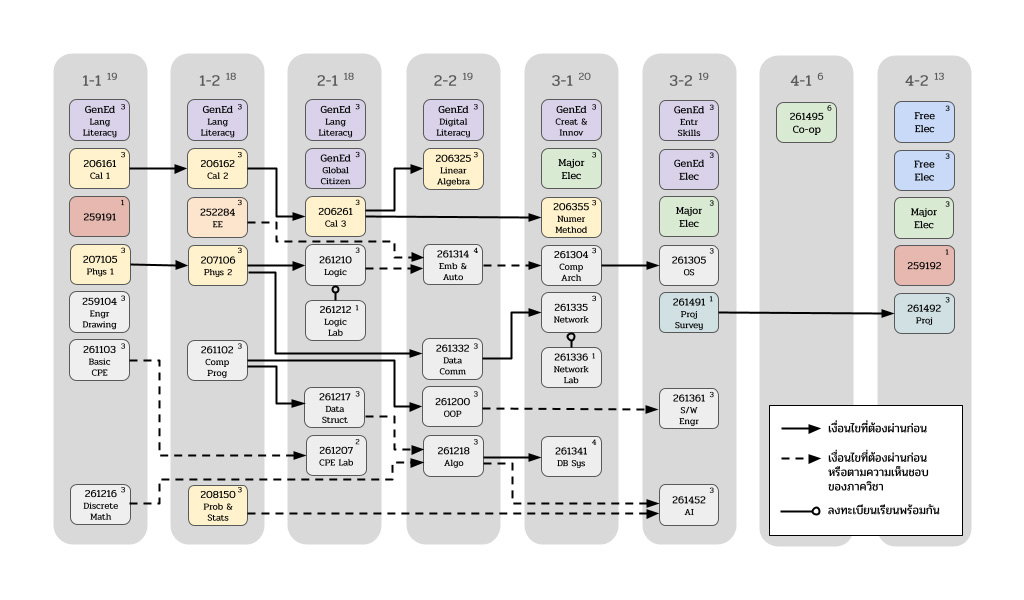
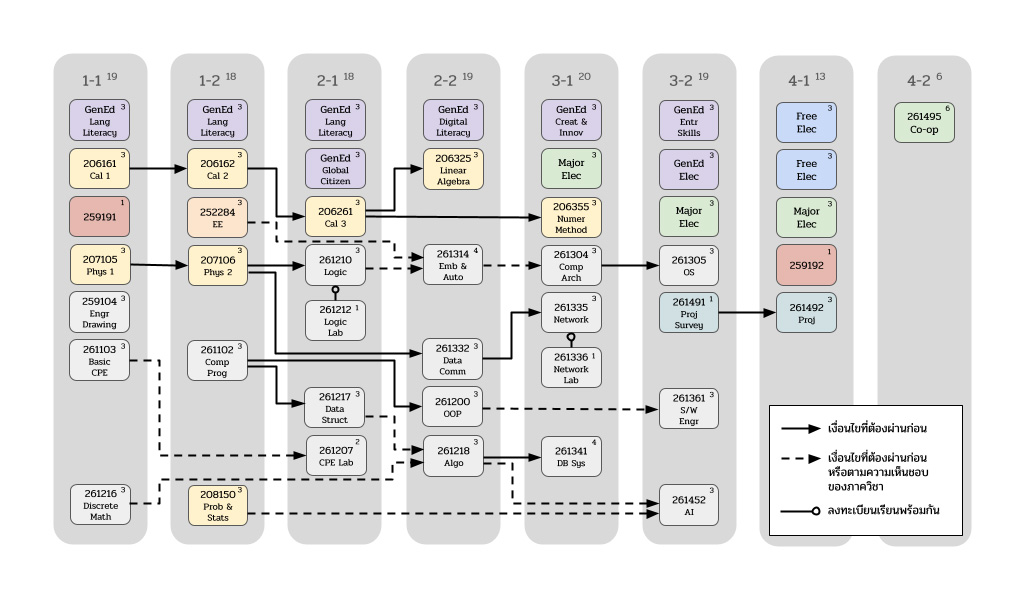
Regular plan and cooperative education (co-op) plan |
|
Co-op semester |
Year 4, Semester 1 or Year 4, Semester 2 |
Highlights of the 2025 revision
• Total credits (minimum) reduced to 132
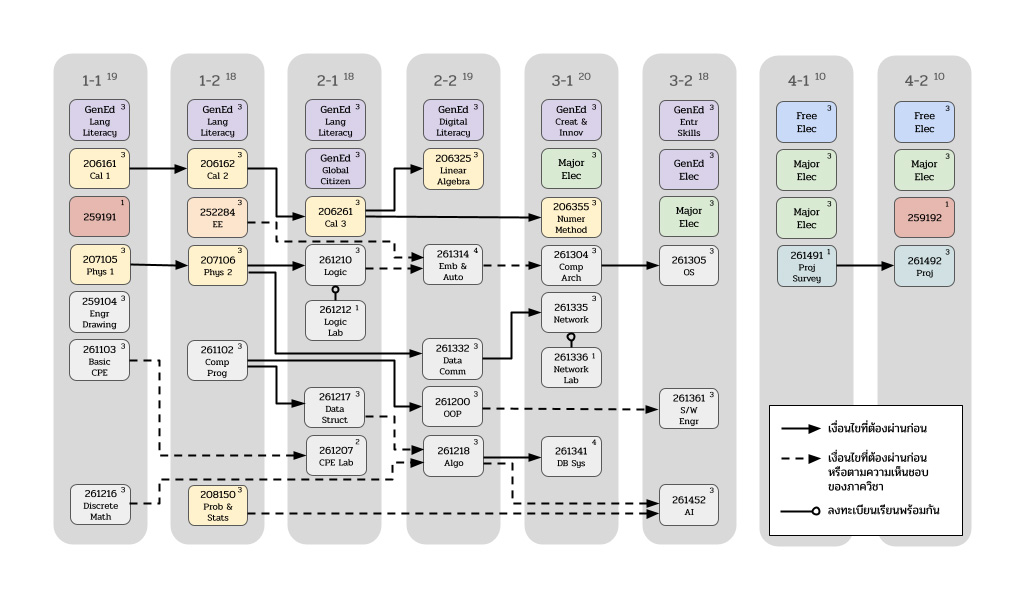
• An average of 6–7 courses (no more than 20 credits) per semester throughout the first three years
• More time to learn and adjust in Year 1, with no Engineering Workshop or Physics Labs
• General Education courses spread across the program rather than concentrated in the final year
• Stronger foundations for advanced courses through related mathematics courses
• Earlier specialization, with major electives starting in Year 3, Semester 1
• Year 4 focuses on specialization and personal interests (major electives, free electives and the senior project), with no more than 8 courses for the whole year
Study Plans
See the full curriculum structure and study plans in the Faculty of Engineering curriculum system (in Thai).
Study plan diagram: Regular plan
Study plan diagram: Co-op plan, Year 4 Semester 1
Study plan diagram: Co-op plan, Year 4 Semester 2
CMU e-Pro & Language Literacy
Students take GenEd Language Literacy courses according to their results in the CMU e-Pro English placement test.
(Details are in the curriculum structure under 1. General Education > 1.1 Required Courses > 1.1.1 Language Literacy.)
Areas of Study
Courses in the program cover the following knowledge and skills.
|
College-Level Mathematics and Basic Science |
Digital Systems and Hardware Design |
Computational Algorithms and Software Development |
|
Software Engineering and Project Management |
Database Systems |
Computer Networks and Cybersecurity |
|
Artificial Intelligence and Machine Learning |
Quantum Computation and Emerging Technologies [optional] |
Attitude and Interpersonal Skil |
Career Paths
|
Software |
Software Engineer, Full Stack Developer, Game Developer, Software Tester, Quality Assurance Engineer |
|---|---|
|
Data and AI |
Data Analyst, Data Engineer, Database Administrator, Machine Learning Engineer |
|
Hardware and security |
Computer Hardware Engineer, Cybersecurity Professionals |
Program Learning Outcomes (PLOs)
|
PLO 1 |
An ability to identify, formulate, and solve complex engineering problems by applying principles of engineering, science, and mathematics |
|---|---|
|
PLO 2 |
An ability to apply engineering design to produce solutions that meet specified needs with consideration of public health, safety, and welfare, as well as global, cultural, social, environmental, and economic factors |
|
PLO 3 |
An ability to communicate effectively with a range of audiences |
|
PLO 4 |
An ability to recognize ethical and professional responsibilities in engineering situations and make informed judgments, which must consider the impact of engineering solutions in global, economic, environmental, and societal contexts |
|
PLO 5 |
An ability to function effectively on a team whose members together provide leadership, create a collaborative and inclusive environment, establish goals, plan tasks, and meet objectives |
|
PLO 6 |
An ability to develop and conduct appropriate experimentation, analyze and interpret data, and use engineering judgment to draw conclusions |
|
PLO 7 |
An ability to acquire and apply new knowledge as needed, using appropriate learning strategies |
|
PLO 8 |
An ability to perform tasks and assigned duties in computer engineering using appropriate methods and tools [for cooperative education plan] |
Admission
Students are admitted through the Thai University Central Admission System (TCAS). Please check the schedule on the website of the Registration Office, Chiang Mai University.
|
Round 1 |
Portfolio, through the Outstanding Academic Achievement program, the Computer Talent program, and the Outstanding Athlete program |
|---|---|
|
Round 2 |
Quota |
|
Round 3 |
Admission (joint direct admission) |
Questions about the curriculum, admission and course registration: Department of Computer Engineering, Tel. +66 53 942 072 ext. 101 (Monday–Friday, 8:30 AM–4:30 PM)