Procedures for new undergraduate student registration at Chiang Mai University for the 2022 Academic Year
- 27 May 2022

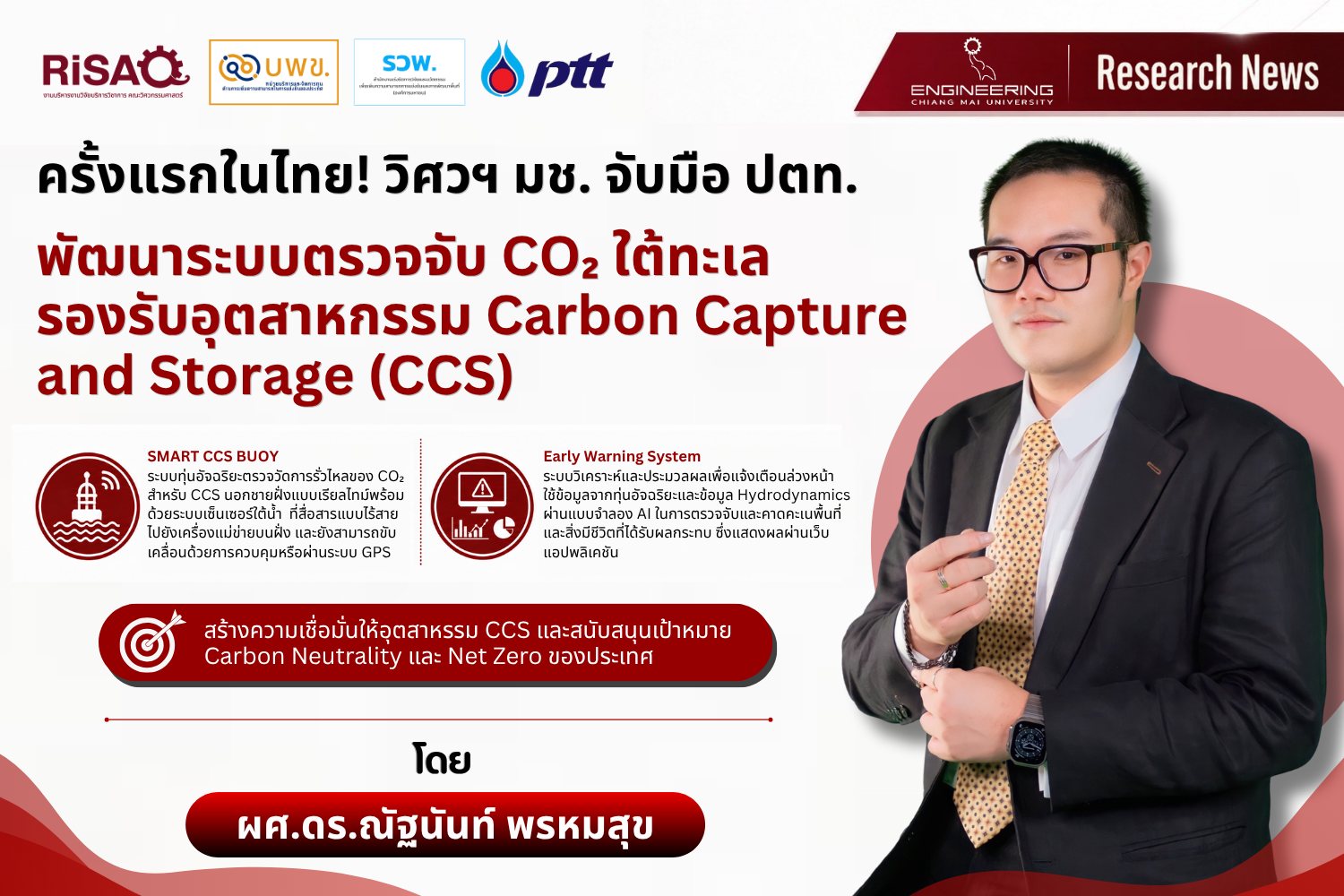
Carbon Capture and Storage (CCS) is one of the key technologies driving Thailand toward Carbon Neutrality and Net-Zero Emissions. However, ensuring the safety and reliability of offshore CCS projects remains a critical factor in gaining acceptance from industry stakeholders and the public.
.
Asst. Prof. Dr. Natthanan Promsuk from the Faculty of Engineering, Chiang Mai University, has led a team of researchers in collaboration with PTT Public Company Limited to successfully develop an underwater CO₂ leakage detection and monitoring system. The project is supported by funding from PMUC and aims to support future CCS developments in Thailand and within the PTT Group.
.
The key innovation is a smart buoy system designed to detect underwater CO₂ leakage. The system integrates IoT technology, Artificial Intelligence (AI), and wireless communication technologies into a single platform. It is capable of pumping seawater from the seabed for analysis while maintaining automatic buoyancy balance, GPS positioning, and real-time remote control capabilities.
.
Sensor data are transmitted through a low-frequency wireless communication network (Sub-1GHz) to a ground station, where AI algorithms and CO₂ dispersion models are used to process and analyze the information. This enables the system to detect leakage in real time, predict leakage volume, assess risk zones and impacts on marine ecosystems, issue early warnings through a Color Warning System, and support rapid and accurate incident management.
.
This project represents another significant milestone for Thailand in advancing CCS safety standards and MMV (Measurement, Monitoring and Verification) systems to meet international standards. It also helps reduce dependence on imported technologies, strengthens the nation’s competitiveness in clean energy innovation, and enhances investor confidence in future CCS developments.
.
Beyond prototype development, the research team has also proposed policy recommendations on carbon monitoring and storage verification to support the establishment of national offshore safety standards. These efforts will serve as an important foundation in driving Thailand toward sustainable Carbon Neutrality and Net-Zero Emissions in the future.